General Knowledge Quiz for High School and College Students: 30 Questions
Berke Başaraner · · 5 min read
On this page
- How to Run a Quiz for Students
- Easy Level: High School General Knowledge Questions (1-10)
- Medium Level: High School and College Questions (11-20)
- Hard Level: College General Knowledge Questions (21-30)
- General Knowledge Questions for Students: Frequently Asked Questions
- What kind of general knowledge questions suit high school and college students?
- How many questions are enough for a student club or class activity?
- Can I run a student quiz in an online class?
- How do I adapt the questions to my own course?
- Play These Student Quiz Questions Live with QuizModeOn
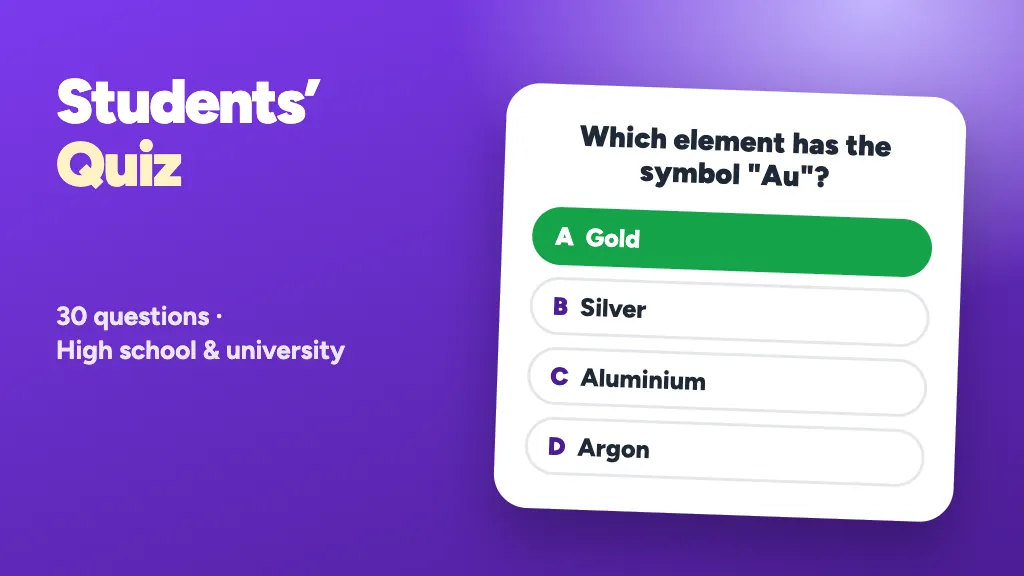
Running a quiz for high school or college students? Below are 30 general knowledge questions for students with multiple-choice answers: 10 easy, 10 medium and 10 hard questions, each with four options (A, B, C, D) and the correct answer. Use them in a class activity, a student club meeting, a dorm night or an online lesson. The questions cover history, science, literature, geography and technology.
How to Run a Quiz for Students
- Split the students into teams of 4 or 5. When teams discuss their answers, quieter students join in too.
- Show the question and the four options on a shared screen, or read them out.
- Give 20 to 30 seconds per question. A correct answer is 1 point.
- In case of a tie, ask one or two extra questions from the hard round for the final.
- A short round of 10 questions fits between lessons, while a club event can use all 30.
Easy Level: High School General Knowledge Questions (1-10)
The warm-up round: basic facts from secondary school.
Question 1: What is the chemical symbol for sodium?
A) Sn B) Na C) Sa D) So
Answer: B) Na
Question 2: What is the capital of Canada?
A) Toronto B) Vancouver C) Ottawa D) Montreal
Answer: C) Ottawa
Question 3: Which gas do plants absorb from the air during photosynthesis?
A) Oxygen B) Carbon dioxide C) Nitrogen D) Hydrogen
Answer: B) Carbon dioxide
Question 4: How many degrees do the interior angles of a triangle add up to?
A) 90 B) 270 C) 360 D) 180
Answer: D) 180
Question 5: Who wrote the play Romeo and Juliet?
A) William Shakespeare B) Charles Dickens C) Jane Austen D) George Orwell
Answer: A) William Shakespeare
Question 6: A light-year is a unit of what?
A) Time B) Speed C) Distance D) Mass
Answer: C) Distance
Question 7: On which continent is the Amazon River?
A) Africa B) South America C) Asia D) Europe
Answer: B) South America
Question 8: What is the most abundant substance in the human body by mass?
A) Protein B) Fat C) Calcium D) Water
Answer: D) Water
Question 9: Which country has New Delhi as its capital?
A) India B) Pakistan C) Bangladesh D) Nepal
Answer: A) India
Question 10: Which is the largest of the Great Lakes by surface area?
A) Lake Michigan B) Lake Superior C) Lake Erie D) Lake Ontario
Answer: B) Lake Superior
Medium Level: High School and College Questions (11-20)
Questions that need a little more general knowledge.
Question 11: Who developed the theory of general relativity?
A) Newton B) Bohr C) Einstein D) Hawking
Answer: C) Einstein
Question 12: In which country did the Renaissance begin?
A) France B) Italy C) England D) Spain
Answer: B) Italy
Question 13: What does DNA stand for?
A) Ribonucleic acid B) Dioxynucleic acid C) Dinitrogen acid D) Deoxyribonucleic acid
Answer: D) Deoxyribonucleic acid
Question 14: Who wrote Crime and Punishment?
A) Dostoevsky B) Tolstoy C) Gogol D) Chekhov
Answer: A) Dostoevsky
Question 15: Where is the headquarters of the United Nations?
A) Geneva B) Paris C) New York D) Brussels
Answer: C) New York
Question 16: Which of these is a programming language?
A) Photoshop B) Python C) Chrome D) Linux
Answer: B) Python
Question 17: In economics, what is the point where supply equals demand called?
A) Equilibrium B) Inflation C) Deflation D) Monopoly
Answer: A) Equilibrium
Question 18: Augustus was the first emperor of which empire?
A) Ottoman B) Persian C) Byzantine D) Roman
Answer: D) Roman
Question 19: Which is the largest country in the world by area?
A) Canada B) Russia C) China D) United States
Answer: B) Russia
Question 20: What is known as the powerhouse of the cell?
A) Nucleus B) Ribosome C) Mitochondria D) Golgi apparatus
Answer: C) Mitochondria
Hard Level: College General Knowledge Questions (21-30)
For the finalists. Not everyone will know these.
Question 21: Which discovery earned Albert Einstein his Nobel Prize in Physics?
A) General relativity B) The photoelectric effect C) Gravitational waves D) Quantum field theory
Answer: B) The photoelectric effect
Question 22: In which country was the Magna Carta signed in 1215?
A) France B) Italy C) England D) Germany
Answer: C) England
Question 23: What number comes next in the Fibonacci sequence 1, 1, 2, 3, 5, 8?
A) 11 B) 12 C) 15 D) 13
Answer: D) 13
Question 24: In which ocean is the Mariana Trench?
A) Pacific Ocean B) Atlantic Ocean C) Indian Ocean D) Arctic Ocean
Answer: A) Pacific Ocean
Question 25: Who wrote Les Misérables?
A) Balzac B) Victor Hugo C) Zola D) Flaubert
Answer: B) Victor Hugo
Question 26: How many bits are there in one byte?
A) 4 B) 16 C) 8 D) 32
Answer: C) 8
Question 27: Which language has the most native speakers in the world?
A) English B) Spanish C) Hindi D) Mandarin Chinese
Answer: D) Mandarin Chinese
Question 28: Who painted the ceiling of the Sistine Chapel?
A) Raphael B) Michelangelo C) Leonardo da Vinci D) Botticelli
Answer: B) Michelangelo
Question 29: What is the smallest prime number?
A) 0 B) 1 C) 2 D) 3
Answer: C) 2
Question 30: Which scientist discovered penicillin in 1928?
A) Louis Pasteur B) Marie Curie C) Joseph Lister D) Alexander Fleming
Answer: D) Alexander Fleming
General Knowledge Questions for Students: Frequently Asked Questions
What kind of general knowledge questions suit high school and college students?
History, geography, literature, science, technology and pop culture questions are the most common. For high school, use the basic facts learned at school. For college, questions that need a bit broader knowledge work well.
How many questions are enough for a student club or class activity?
A round of 10 questions fits at the start or end of a lesson. For a club event or contest, 20 to 30 questions are a good fit. Split this list into three rounds: easy, medium, hard.
Can I run a student quiz in an online class?
Yes. Add the questions to a quiz platform and let students join from their phones or laptops. The next section explains how to do this with QuizModeOn.
How do I adapt the questions to my own course?
Keep the same structure and add questions from your own subject: four options, one correct answer, ordered from easy to hard. A short quiz is a great way to review before an exam.
Play These Student Quiz Questions Live with QuizModeOn
Instead of reading the questions out loud and counting points by hand, you can build the quiz in QuizModeOn Quiz: add your questions in the portal, students join from their own devices, the questions appear on a shared screen and the leaderboard updates after every answer. For a step-by-step guide, read how to host a quiz with QuizModeOn.
Looking for more questions? See our lists of multiple-choice quiz questions and 75+ fun general knowledge quiz questions, or the general knowledge quiz for kids for younger players.

Written byBerke BaşaranerCo-Founder · QuizModeOn